
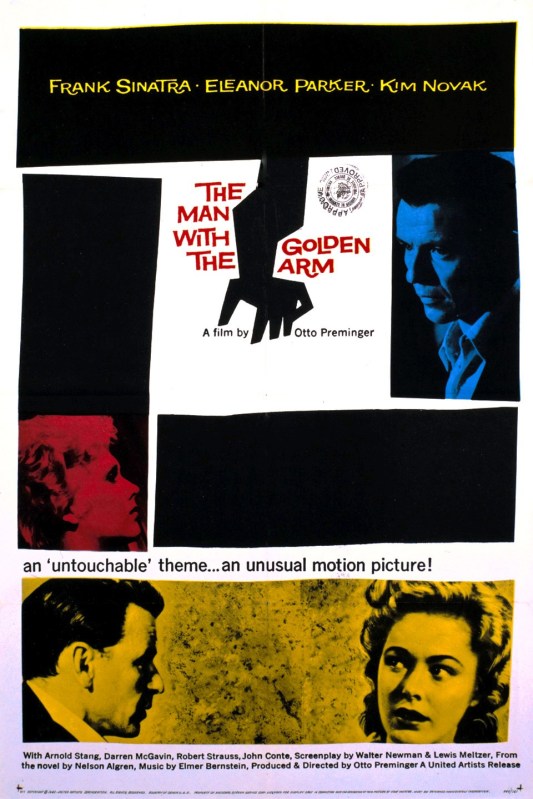
Directed by Otto Preminger
Written by Walter Newman and Lewis Meltzer
In terms of poker, and especially poker films, the dealer often gets underserved, and even when they are mentioned it’s often in a bad light, because they’re a “mechanic”, a cheat who takes advantage of the weakness of the gamblers sitting at their table. In the real world, even today, I’ll see players complain to dealers when things don’t go their way. Poor treatment of a dealer is never acceptable, they are there doing their job, and in the case of regulated games, to do it completely fairly. Dealers are a godsend, they make the game go quicker and smoother, and I am eternally grateful for their services. Don’t get me wrong, I actually love dealing in our home game, and think I’m pretty good at it, but it’s more often than not a thankless job. In the case of The Man with the Golden Arm, renowned director Otto Preminger finds a story of a dealer who not only has an arm for dealing, but also one for drugs, spinning tale that interweaves the two perfectly.
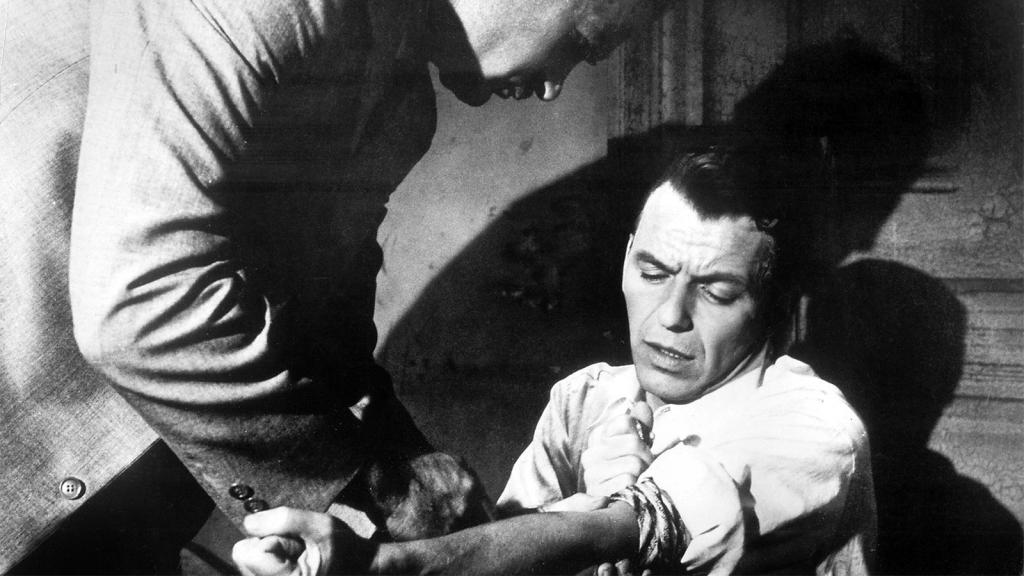
Frankie Machine (Frank Sinatra) is fresh out of prison, having served time for his addiction to heroin. Upon returning to Chicago, he’s greeted by long lost friends. Louie (Darren McGavin), his old dealer; Schwiefka (Robert Strauss), his old employer who hired him to deal his underground poker games, Sparrow (Arnold Stang), his goofy friend who would follow him anywhere; Zosh (Eleanor Parker), his wife who has waited patiently in her wheelchair, to which she is confined after an auto accident; and lastly Molly (Kim Novak), his downstairs neighbor who might be more than a friend. This cast of characters all push and pull for Frankie’s attention, each for their own selfish reasons, ultimately causing Frankie to relapse, bomb his audition to be a drummer (his proclaimed new profession), and get wrapped back up in dealing where he gets caught cheating. His life has once again found itself in a downward spiral.
For a film released in 1955, this is extremely progressive in its depiction of drug addiction, particularly heroin. It doesn’t pull any punches and Frank Sinatra is incredible in the role of Frankie, earning him an Academy Award nomination for Best Actor for his performance. It’s an upsetting film to see the world of a man unravel in the manner in which it does. He leaves prison clean, ready to take on the world and start over, but his network does him no favors pulling him back in to his old habits and destructive tendencies, mostly all for their own personal gain. These are not true friends to Frankie.
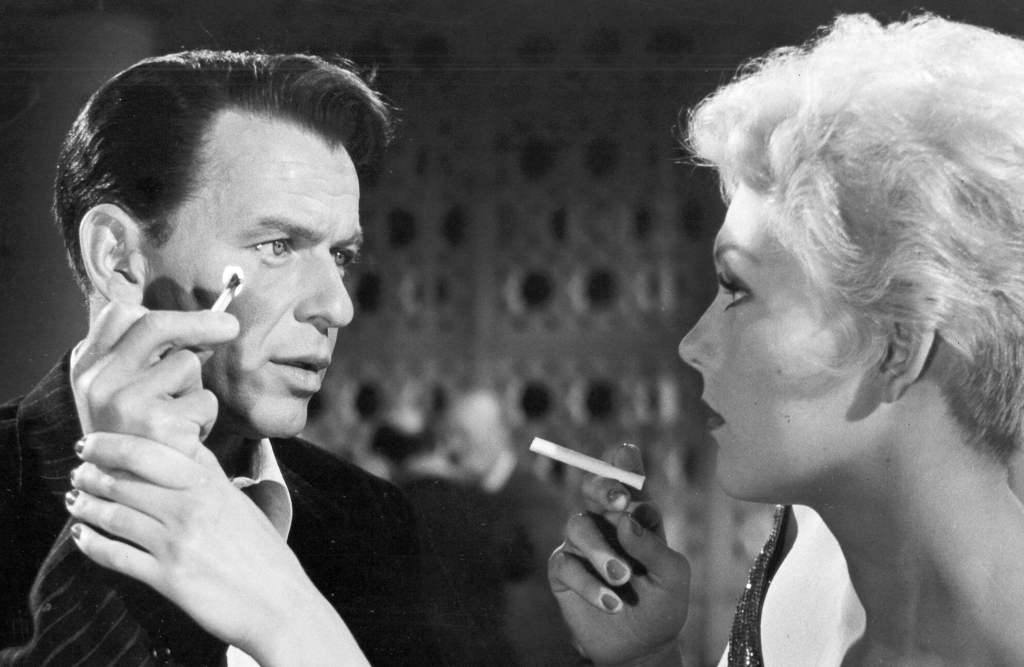
Preminger helms the picture as only he can, with a keen eye to performance and mood, capturing the harrowing story in stark black and white photography, in grim and often upsetting detail, complimented perfectly with a jazzy score from Elmer Bernstein. Audiences at the time likely did not respond well to this new, very realist view of the world. It’s the type of upsetting depiction of real life that patrons were looking to escape with their entertainment, but the mid-50s was also a time when cinema began to transform to showing these kinds of stories. The Man with the Golden Arm is preceded by Elia Kazan and Marlon Brando’s A Streetcar Named Desire and On the Waterfront. Preminger and Sinatra collaborate to contribute to the growing art form with The Man with the Golden Arm.
Poker Analysis
It’s important to note that while Frankie is the dealer in this movie, he also plays, something you’ll commonly see in underground and home games without a dedicated dealer only. What I found interesting is that he plays for the “house”. Louie organizes the game, and must receive some benefit from hosting. It’s unclear whether he takes what is called a “rake” from the game, which could either be a set amount removed from each pot and kept by the house, or a set amount the players must pay the house for a seat in the game, either up front or hourly say. But my guess in this scenario is that the “rake” is whatever Frankie wins as the dealer, which it’s made clear he is a very sharp player in addition to being a great dealer. I’m sure Frankie is entitled to a certain percentage cut of these winnings, but in this case the “rake” of the game is variable and dependent upon the performance of Frankie.
In this sense, Frankie seems akin to a “prop player”, who is a player paid by an establishment to get games going, and to keep them going. In this scenario, the player is not also a dealer, but gets monetary benefit from playing at a certain location. They play their own money, but have an obligation to get and keep games running, allowing the establishment to make their money in whatever method of “rake” they choose.
The Game
For the first time we see that this group of players is playing Five Card Stud, which I don’t think we’ve talked about yet. Like Five Card Draw, the goal is still to make the best five card poker hand, but instead of the cards being hidden in each players hand, with an option to draw more cards in an attempt to make a better hand, in stud, only the first card is hidden, or down. The deal starts with each player receiving one down card and one up card, a face-up card that every player can see. Betting then continues with each additional street of action representing an additional up card. So you start with two cards (one down and one up), then receive an additional up card, then betting, then an additional up card, etc. until each remaining player has five total cards (one down and four up).
Because the game consists of 80% of the cards exposed, and only one hidden, it plays a lot more straightforward than a draw game where all the cards are hidden. It’s still a partial information game, as the one down card can play a major role in the result of the hand, but with 80% of the hand known, it’s much easier to discern whether it’s even possible for your opponent to have a better hand.
Hand #1
In the first hand of action, we join already on fifth street, the final card of the hand. With Frankie dealing, Seat 1 is announced as having three Aces for a possible full house. Seat 2 is announced as having two pair, also for a possible full house. The dealer, Frankie, has a possible straight flush, which is five cards of the same suit in sequential order. In this case, he could also just have a flush, or just have a straight, but in either case the hand loses to a full house.
Seat 1, with trip Aces, bets out $200. Seat 2, with two pair, raises it to $400. At this point Frankie raises another $300 to a total of $700. At this point the other two players in the hand are WAY out of line, as they begin discussing the hand openly and determining whether Frankie has the straight flush or not. This is very poor form, as the two players are essentially teaming up to beat Frankie. And while that may be their goal, to beat Frankie, it is inappropriate to discuss the hand while it’s in progress, unless it’s heads-up (between only two players), and in that case only the players in the hand should be talking about it. Case in point, Seat 2 convinces Seat 1 that Frankie is bluffing, so Seat 1 calls, but Seat 2 then re-raises again to $1,200! This almost feels like an “angle”, an action by a player to influence action to their benefit, and if often something shady like getting a player to discard their hand incorrectly, or in this case to call when they knew they would raise.
However, Frankie once again re-raises to $1,700, which prompts Seat 1 to quickly fold in disgust. It’s at this point that Frankie employs some nice “speech play”. Now that the action is heads-up between two players, this is perfectly acceptable. By constantly telling Seat 2 the action is on him, he rushes the player, applying pressure, and eventually gets a fold out of him. Disgruntled by the hand, Seat 2 urges Frankie to reveal what he had and after not receiving an answer he reaches over the table to turn over the lone down card, only to find out he was in fact bluffing, with only a pair of nines. This is also very bad form, as Frankie is not obligated to show his hand, and it can often be beneficial to not show, driving your opponent mad. What’s interesting is the two other players get upset, almost as if Frankie had cheated them, but in this case by bluffing, to me it’s clear he wasn’t cheating, he just was able to outplay them. If cheating, he would have had the straight flush and had them call. Either way it’s an example of power poker, with Frankie forcing the other two out with aggressive betting. From a strategic standpoint, it’s likely folly for Seat 2 to fold, unless he only had the two pair. At the very least, he should have stuck to just calling Frankie initial re-raise. By raising again himself, he opened to door for Frankie to 5-bet (place the fifth bet of the street into the pot). A 5-bet in any game looks extremely strong. If he had just called the 3-bet, even if he was losers, the pot wasn’t so bloated at that point for it be a mistake. My read on the hand is that they were likely all full of shit and didn’t have more than what they were showing, which made Frankie’s 5-bet more than enough to finally win.
This hand has just about everything in it, and it only takes about 5 minutes of screentime. We get to see poor etiquette with the table talk, angling by Seat 2 to induce Seat 1 to put more money in the pot, expert speech play from Frankie, and an elite level bluff from him as well. Not to mention the poor form of reaching across the table to reveal another players hand. This is an example of a really well done poker hand in a movie.
Hand #2
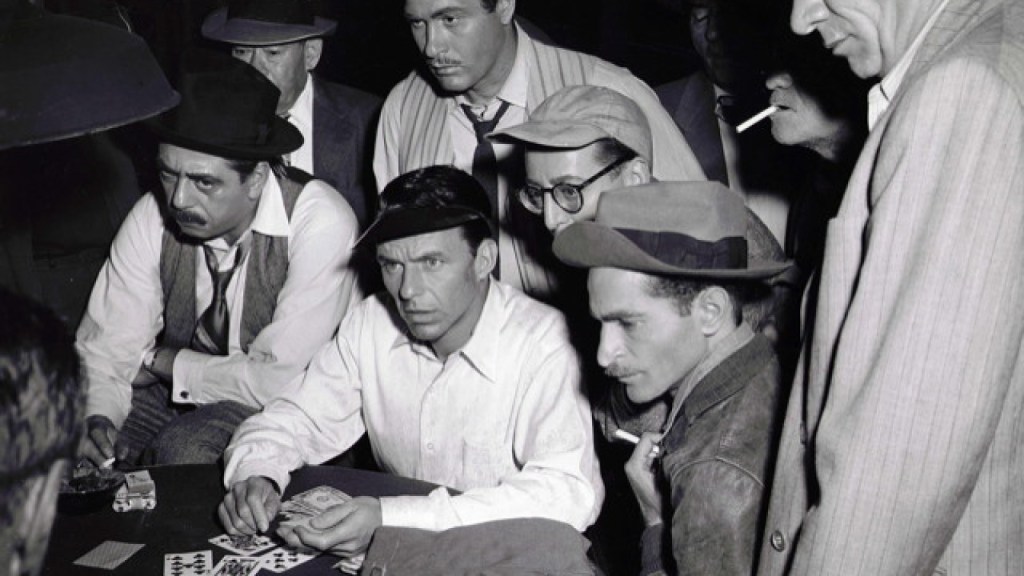
There is only one other significant hand shown in the film, but it’s important to the storyline, as it turns out that Frankie is cheating this time around. The hand itself is somewhat uninteresting.
We get to see this one from the beginning, as Seat 1 shows a 3, Seat 2 a King, and the dealer/Frankie shows a Jack. As the high card, action starts with the King, who bets out $100, garnering a call from both opponents. Seat 1 now pairs his 3, giving him high hand showing, and the betting lead which he takes to bet out $200. Seat 2 now calls showing King/Ten, and Frankie calls showing Jack/Seven. On fourth street, Seat 2 now pairs his King (KK10) and leads out for a bet of $500. After pairing his Jack, Frankie calls, as does Seat 1 still with only a pair of 3s. On fifth street, Seat 1 improves to three treys, betting out $500. It’s at this point the hand ends, as Frankie gets sloppy riffling the cards, which is noticed by Seat 1 who reaches over and grabs his arm to reveal a Jack on the bottom of the deck.
There is not much to say about this hand strategically, as it’s pretty meh and doesn’t fully play out. But it is an important hand for the story of the movie, as we are peak downswing for Frankie when it comes to relapsing. He is hungry for a fix, and strung out on a 48 hour bender of playing cards.
 Corndog Chats