

Written & Directed by Wong Kar-Wai
Thus far in this World of Wong Kar-Wai marathon, director Wong has stayed pretty close to his trademark narrative style. But with 1994’s Ashes of Time, he strays from this comfort zone and dabbles in Wuxia, a style of Chinese film which is defined by the depiction of the martial arts. Wong is no stranger to violence in his films, highlighting the exploits of modern-day gangsters on multiple occasions, but he has not explored this kind of violence, nor has he explored this time period. While changing styles and trying something different is often proof that such a famed director can handle any story, any time, any format, it also has me a little worried having not seen this film before. Can he pull it off?
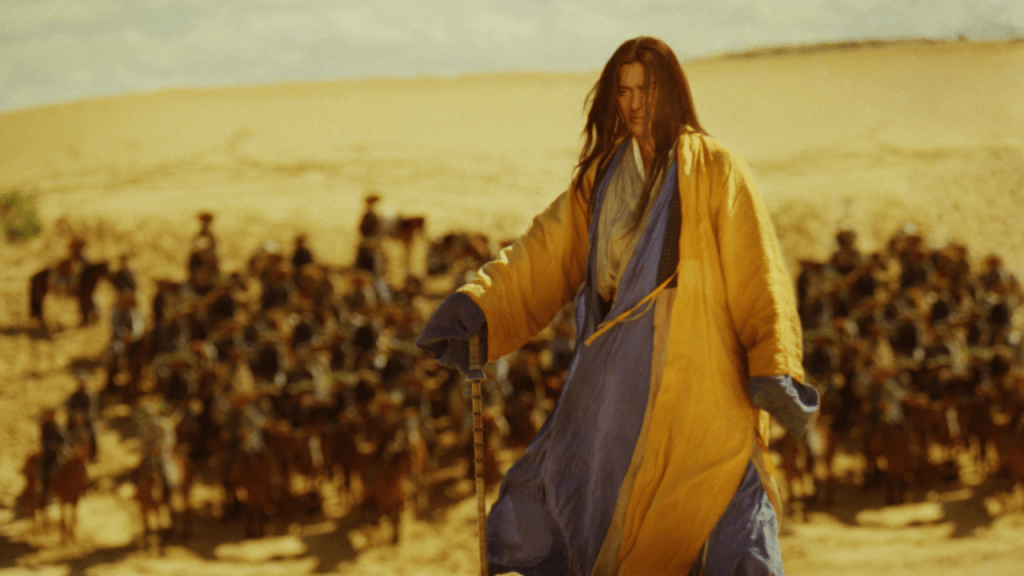
The story follows Ou-yang Feng (Leslie Cheung), a retired swordsman for hire living in a small village in the desert, and his many interactions with friends, foes, and those seeking the employment of a talented swordsman. The company he keeps is varying, including longtime friend Yaoshi Huang (Tony Leung Ka Fai), who visits each year; a blind swordsman (Tony Leung) has troubles with his wife Peach Blossom (Carina Lau), while helping avenge a peasant girl (Maggie Cheung). Other swordsmen (Jacky Cheung) appear, and stories are told of the enigmatic Murong (Brigitte Lin)
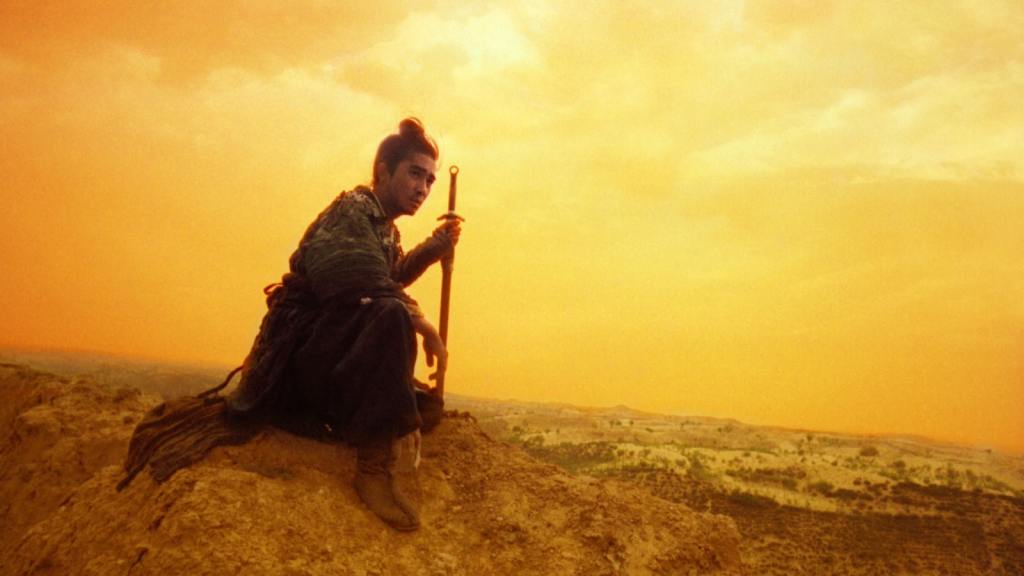
The plot, as you can surmise by my struggle to succinctly and coherently summarize, is one of the attributes of the movie which people seem to struggle the most with. However, while I admit its difficulty in summarization, I cannot say it was a distraction when viewing the film. Orientation of which character is related to which other character and their motives, etc. are held somewhat at a distance, but not impossible to follow. And quite frankly not necessarily the heart of the movie in the first place. As in past films, Wong Kar-Wai is developing something more of an atmosphere than a narrative. That is not to say he’s not also a great writer capable of assembling and piecing together these delicate and emotionally thematic films, it’s one of his great super powers. But the beat-by-beat nature of the sequential narrative is not one of his principle interests as a filmmaker.
He’s a visual storyteller, and you can tell with a film like Ashes of Time, whose use of color, blocking and camera magic is among its greatest qualities. The sequencing can be disorienting at times however. The camera swoops about, with canted angles, quick cuts and Wong’s trademark blur. All together it gives the film a feeling that everything is slightly zoomed in, causing a dizzying feeling of both time and space. While assuredly intentional in a narrative like this one, whose structure is told over the course of multiple seasons delineated by title cards, it still manages to detract from the viewing experience. I caught glimpses of beauty, but was never able to luxuriate in them.
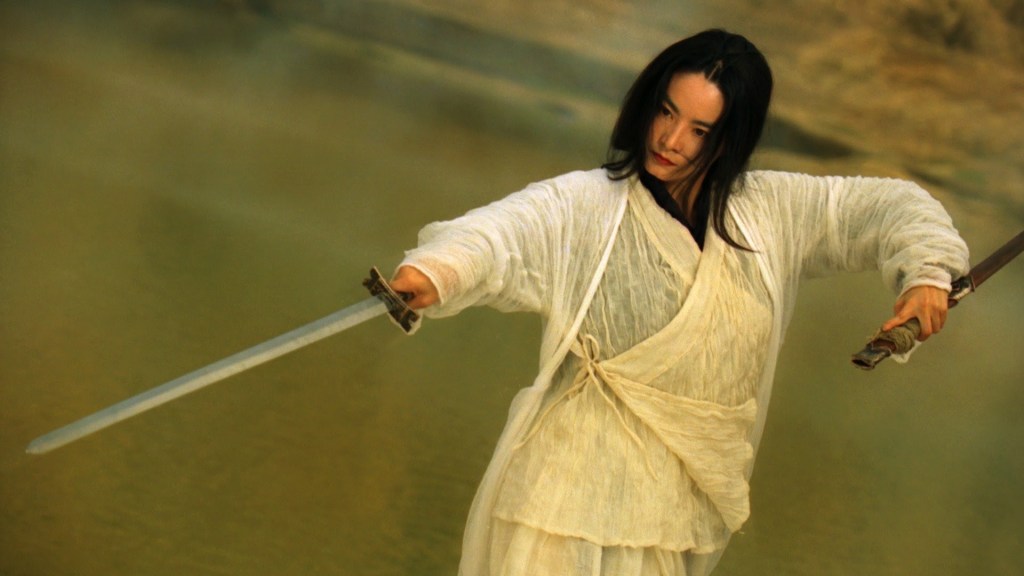
I watched, of course, the “redux” version of the film, which from my understanding is the only version of the film currently available, but differs only slightly from the original version put out by Wong Kar-Wai in 1994. In the end, I came around on what was a largely frustrating viewing experience. The way the film disorients does not make for a pleasing time overall, but the cyclical nature of the narrative comes back around in the end in a kind of “aha!” moment, bringing me back around for another consideration. Wong Kar-Wai’s use of camera, and most particular his ability to develop complex themes and narratives left me wanting to revisit the film immediately. Perhaps Ashes of Time will grow in my estimation as time goes on, as I see them film multiple times.
 Corndog Chats